


Page 183 - -25-0508(ALLs)
P. 183
The International Journal of the Royal Society of Thailand

                  Volume XVI-2024 (Special Issue)

                  of Nakhon Si Thammarat were hardly aware that a cremation was taking place” (1950: 40).

                  By contrast, the event that attracted a large gathering of locals was the celebration of
                  the Phra Borommathat Stupa in Nakhon Si Thammarat, a major religious festival featuring
                  entertainment, which King Rama V also attended.
                           When King Chulalongkorn attended the Phra Borommathat Stupa event in 1905,
                  he took photographs with his personal photography equipment. Although there is no mention of
                  any Nora  performance in the royal letters to the Council of Regents, the photographic evidence

                  from that visit confirms that Nora performers took part. They are the first photographic evidence
                  of Nora and confirm that the King observed this local performance. It is also highly likely that
                  he personally captured these photographs of Nora performers.
                      2.2  Examining King Rama V’s Nora Photographs in Their Social and Cultural Context
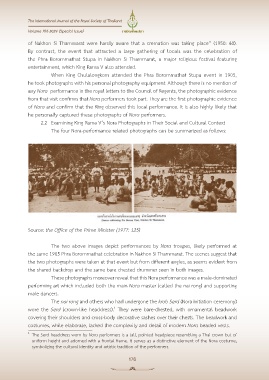
                           The four Nora-performance related photographs can be summarized as follows:


                  Source: the Office of the Prime Minister (1977: 125)


                           The two above images depict performances by Nora troupes, likely performed at
                  the same 1905 Phra Borommathat celebration in Nakhon Si Thammarat. The scenes suggest that

                  the two photographs were taken at that event but from different angles, as seems evident from
                  the shared backdrop and the same bare chested drummer seen in both images.
                           These photographs moreover reveal that this Nora performance was a male-dominated
                  performing art which included both the main Nora master (called the nai rong) and supporting
                  male dancers.
                           The nai rong and others who had undergone the krob Serd (Nora initiation ceremony)

                  wore the Serd (crown-like headdress).  They were bare-chested, with ornamental beadwork
                                                        1
                  covering their shoulders and cross-body decorative sashes over their chests. The beadwork and
                  costumes, while elaborate, lacked the complexity and detail of modern Nora beaded vests.

                  1   The Serd headdress worn by Nora performers is a tall, pointed headpiece resembling a Thai crown but of
                    uniform height and adorned with a frontal frame. It serves as a distinctive element of the Nora costume,
                    symbolizing the cultural identity and artistic tradition of the performers.

                                                              176


                                                                                                                 7/7/2568 BE   15:17
       -25-0508(001)P5.indd   176
       -25-0508(001)P5.indd   176                                                                                7/7/2568 BE   15:17

