


Page 184 - -25-0508(ALLs)
P. 184
The International Journal of the Royal Society of Thailand

                                                                                       Volume XVI-2024 (Special Issue)

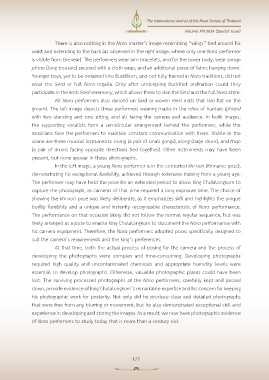
                            There is also nothing in the Nora master’s image resembling “wings” tied around his

                   waist and extending to the back (as observed in the right image, where only one Nora performer
                   is visible from the rear). The performers wear arm bracelets, and for the lower body, wear sanap
                   phlao (long trousers) secured with a cloth wrap, and an additional piece of fabric hanging down.
                   Younger boys, yet to be ordained into Buddhism, and not fully trained in Nora traditions, did not
                   wear the Serd or full Nora regalia. Only after undergoing Buddhist ordination could they

                   participate in the krob Serd ceremony, which allows them to don the Serd and the full Nora attire.
                            All Nora performers also danced on Sard or woven reed mats that laid flat on the
                   ground. The left image depicts three performers wearing masks in the roles of hunters (phran)

                   with two standing and one sitting, and all facing the camera and audience. In both images,
                   the supporting vocalists form a semicircular arrangement behind the performers, while the
                   musicians face the performers to maintain constant communication with them. Visible in the
                   scene are three musical instruments: mong (a pair of small gongs), klong (large drum), and thap
                   (a pair of drums facing opposite directions tied together). Other instruments may have been

                   present, but none appear in these photographs.
                            In the left image, a young Nora performer is in the contorted khi non (Kinnaree pose),
                   demonstrating his exceptional flexibility, achieved through extensive training from a young age.

                   The performer may have held the pose for an extended period to allow King Chulalongkorn to
                   capture the photograph, as cameras of that time required a long exposure time. The choice of
                   showing the khi non pose was likely deliberate, as it emphasizes skill and highlights the unique
                   bodily flexibility and a unique and instantly recognizable characteristic of Nora performance.
                   The performance on that occasion likely did not follow the normal regular sequence, but was

                   likely arranged as a pose to enable King Chulalongkorn to document the Nora performance with
                   his camera equipment. Therefore, the Nora performers adopted poses specifically designed to
                   suit the camera’s requirements and the King’s preferences.

                            At that time, both the actual process of posing for the camera and the process of
                   developing the photographs were complex and time-consuming. Developing photographs
                   required high quality and uncontaminated chemicals and appropriate humidity levels were
                   essential to develop photographs. Otherwise, valuable photographic plates could have been
                   lost. The surviving processed photographs of the Nora performers, carefully kept and passed

                   down, provide evidence of King Chulalongkorn’s remarkable expertise and his concern for keeping
                   his photographic work for posterity. Not only did he produce clear and detailed photographs
                   that were free from any blurring or movement, but he also demonstrated exceptional skill and

                   experience in developing and storing the images. As a result, we now have photographic evidence
                   of Nora performers to study today that is more than a century old.


                                                                177


                                                                                                                 7/7/2568 BE   15:17
       -25-0508(001)P5.indd   177                                                                                7/7/2568 BE   15:17
       -25-0508(001)P5.indd   177

