


Page 191 - -25-0508(ALLs)
P. 191
The International Journal of the Royal Society of Thailand

                  Volume XVI-2024 (Special Issue)


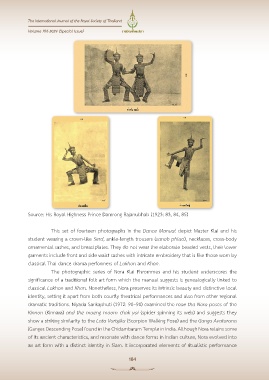
                  Source: His Royal Highness Prince Damrong Rajanubhab (1923: 83, 84, 85)


                           This set of fourteen photographs in the Dance Manual depict Master Klai and his
                  student wearing a crown-like Serd, ankle-length trousers (sanab phlao), necklaces, cross-body
                  ornamental sashes, and breastplates. They do not wear the elaborate beaded vests, their lower

                  garments include front and side waist sashes with intricate embroidery that is like those worn by
                  classical Thai dance drama performers of Lakhon and Khon.
                           The photographic series of Nora Klai Phrommes and his student underscores the
                  significance of a traditional folk art form which the manual suggests is genealogically linked to

                  classical Lakhon and Khon. Nonetheless, Nora preserves its intrinsic beauty and distinctive local
                  identity, setting it apart from both courtly theatrical performances and also from other regional
                  dramatic traditions. Niyada Sarikaphuti (1972: 90–91) examined the mae tha Nora poses of the
                  Kinnon (Kinnara) and the maeng moom chak yai (spider spinning its web) and suggests they

                  show a striking similarity to the Lata Varisjika (Scorpion Walking Pose) and the Ganga Avatarana
                  (Ganges Descending Pose) found in the Chidambaram Temple in India. Although Nora retains some
                  of its ancient characteristics, and resonate with dance forms in Indian culture, Nora evolved into
                  an art form with a distinct identity in Siam. It incorporated elements of ritualistic performance


                                                              184


                                                                                                                 7/7/2568 BE   15:17
       -25-0508(001)P5.indd   184
       -25-0508(001)P5.indd   184                                                                                7/7/2568 BE   15:17

